REVIEW · NEW DELHI
6 Days Golden Triangle Tour Delhi Agra and Jaipur By Private Car
Book on Viator →Operated by Hola India Tour · Bookable on Viator
A first-time India trip needs a clean route. This private car Golden Triangle packs Delhi, Agra, and Jaipur into a smooth loop, with hotel pickup, a tour guide, and time-saving transfers that keep you from living on the roadside. I especially like the early start for sunrise at the Taj Mahal, and I also like how the days mix big-ticket sights with real-world stops like temples, stepwells, and local evening rituals. One heads-up: the itinerary is fairly full, so you’ll want comfortable shoes and an easy-go with early mornings.
The real value here is that you’re not just ticking monuments. You’re moving between UNESCO-class sights and cultural landmarks with a guide who can explain what you’re looking at, while your driver handles the long stretches. If you prefer a super-slow pace or lots of free time each day, you may feel scheduled—but if you want the highlights without chaos, this format works well.
In This Review
- Key highlights to know before you go
- How this private Golden Triangle trip feels in real life
- Day 1 in Delhi: landing, pickup, and an easy start
- Day 2 in Delhi: Mughal grandeur, Sikh calm, and classic landmarks
- Jama Masjid and Humayun’s Tomb (Mughal scale up close)
- President House, Parliament House, and India Gate exteriors (modern nation symbolism)
- Bangla Sahib (a temple where the pace slows)
- Qutub Minar (the skyline moment you’ll remember)
- Day 3 to Agra: the drive, then the fort-and-tomb highlight reel
- Agra Fort: palaces inside a fortress
- Etimad Ud Daulah (Mini Taj): why it’s worth your time
- Mehtab Bagh at sunset: Taj views without the crowd crush
- Day 4: Taj Mahal at sunrise plus Fatehpur Sikri to keep the momentum
- Sunrise at the Taj Mahal: the emotional payoff
- Fatehpur Sikri: the ghost town stop with real atmosphere
- Chand Baoli: one of India’s older stepwells
- Jaipur check-in: recharge for the palace day
- Day 5 in Jaipur: Amber Fort, Hawa Mahal, City Palace, and an evening aarti
- Amber Fort and elephant ride (and what to know)
- Jal Mahal: quick photo stop with a view
- Jantar Mantar and Hawa Mahal: science meets drama
- Lunch at an AC multi-cuisine restaurant
- City Palace and museum: where styles mix
- Patrika Gate and the night temple option
- Day 6: Galta Ji monkeys, then the drive back to Delhi
- Galta Ji: temple complex with monkeys and mountain views
- Price and value: what $231.86 per person really buys
- The small choices that affect your comfort
- Should you book this Golden Triangle private car tour?
- FAQ
- Pickup and drop-off: how does it work?
- What’s included in the tour price?
- Are meals like lunch and dinner included?
- Is this tour private?
- How long is the Golden Triangle route?
- What if I need to cancel?
Key highlights to know before you go

- Door-to-door private transfers between Delhi, Agra, and Jaipur so you can focus on sights instead of logistics
- Sunrise Taj Mahal plus a later viewpoint stop at Mehtab Bagh for different lighting and photos
- Delhi’s contrast day: Mughal monuments, a Sikh gurdwara, a war memorial, and the iconic Qutub Minar
- Agra beyond the Taj: Agra Fort and Itimad-ud-Daulah (Mini Taj) for more atmosphere and variety
- Jaipur’s palace-and-views mix: Amber Fort, Jantar Mantar, Hawa Mahal, City Palace, and temple evening aarti
How this private Golden Triangle trip feels in real life
A Golden Triangle is a classic reason people come to North India in the first place: three cities, three eras, and a stacked lineup of sights that make sense together. The part that makes this version feel practical is the private car for all transfers and sightseeing. That means you’re not constantly reorganizing days around shared transport schedules.
You also get a professional tour guide for the main sightseeing blocks. That matters because many of the best details at these sites are visual but also interpretive. Without context, you can still enjoy the architecture. With context, you catch why a dome sits the way it does, what a courtyard plan was meant to do, and how the styles connect across centuries.
Add in hotel pickup and drop-off in New Delhi, plus breakfast included for your five nights (if you choose that hotel option). You get a clear baseline: morning begins with breakfast, daytime is sight-focused, and evenings are for rest before the next city jump.
Day 1 in Delhi: landing, pickup, and an easy start

On arrival at Indira Gandhi International Airport, you’re met by a representative holding your name sign. That’s the kind of small thing that reduces stress immediately, especially after a long flight. You head straight to your pre-booked hotel and settle in for the night in Delhi.
Even if you have jet lag, this day helps you avoid the classic mistake: trying to squeeze sightseeing in right after you land. Instead, you’re positioned for a proper day of monuments on Day 2.
Day 2 in Delhi: Mughal grandeur, Sikh calm, and classic landmarks
Delhi can feel huge and noisy, but this day gives it a structured rhythm. You’ll head out with your driver and meet a professional guide, then tour a set of landmarks that show different faces of the city.
Jama Masjid and Humayun’s Tomb (Mughal scale up close)
Jama Masjid is famous for a reason: it’s massive, and the space around it makes you feel small in a good way. The big takeaway is how the mosque’s layout supports crowds and ceremony.
Humayun’s Tomb offers the other side of Mughal design: graceful proportions and a peaceful feel inside its walled setting. It’s an ideal “sit with it” stop. You’ll likely notice the careful symmetry and how the tomb complex works as a place of memory, not just a building.
President House, Parliament House, and India Gate exteriors (modern nation symbolism)
You’ll see President House and Parliament House from the outside, plus India Gate, a war memorial. These are quick stops, but they’re useful because they anchor Delhi’s present in the same loop as its older monuments.
Bangla Sahib (a temple where the pace slows)
Bangla Sahib is a Sikh gurdwara, and the highlight is that it’s a living place of worship. The huge community kitchen that feeds people regardless of background is one of those details that hits harder than any photo. You get a sense of daily life here, not just sightseeing.
Qutub Minar (the skyline moment you’ll remember)
Qutub Minar is a brick tower from the 10th century and it’s one of those landmarks you see and instantly understand why it’s iconic. The best part is how it shifts from “wow, it’s tall” to “wait, the details are fascinating” once you’re close.
Lunch is handled with a stop on the day, and then you return to your hotel. After a full day like this, you’ll appreciate going back to your room while the city is still spinning outside.
Day 3 to Agra: the drive, then the fort-and-tomb highlight reel
You travel from Delhi to Agra by car along Yamuna Highway (about 3 hours / roughly 200 km). On paper it’s a straightforward transfer. In real life, that drive is where you can reset your focus for Agra, since Delhi’s monument intensity is about to change.
After checking into your hotel, you get Agra sights with your guide.
Agra Fort: palaces inside a fortress
Agra Fort is a big one for people who want more than one “main attraction.” It’s a fortress complex built in the 16th and 17th centuries, with palaces inside. The fort experience is about scale and layers: you’re not just looking at walls, you’re moving through spaces tied to court life.
Etimad Ud Daulah (Mini Taj): why it’s worth your time
Etimad Ud Daulah, sometimes called Mini Taj, is the kind of stop that surprises first-timers in a good way. It’s considered one of the first mausoleums built entirely of white marble, and the stonework feels delicate compared to the larger Taj. This is one of the best “architecture nerd” stops without needing to be an expert.
Mehtab Bagh at sunset: Taj views without the crowd crush
You’ll also visit Mehtab Bagh, described as the Moon Light Garden, where you can admire the view of the Taj Mahal at sunset. Even if you’ve seen Taj photos before, this viewpoint can feel different because the Taj sits in your frame like part of a composition, not just a monument.
After sightseeing, you return to the hotel and rest. Day 4 is an early one, so this downtime isn’t optional.
Day 4: Taj Mahal at sunrise plus Fatehpur Sikri to keep the momentum
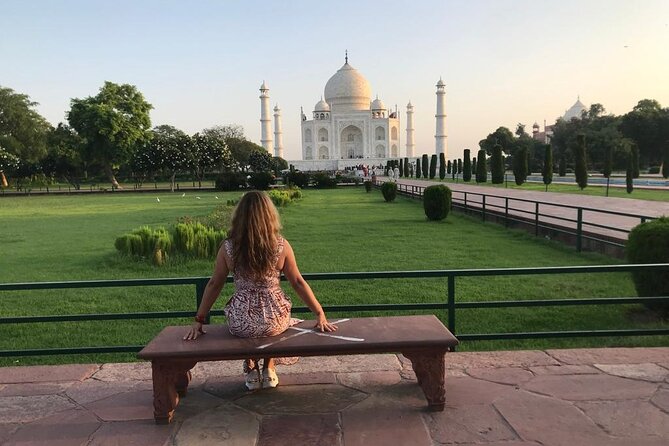
This is the day that makes the whole itinerary feel like a highlight tour done right. You get up early to visit the Taj Mahal at sunrise. The idea is simple: softer light, less heat, and a first glimpse that feels almost unreal compared to midday photos.
Sunrise at the Taj Mahal: the emotional payoff
The Taj Mahal is widely celebrated, but the practical reason to do it at sunrise is the atmosphere. You’ll see the white marble glow as the day wakes up. It’s an experience that works even if you’re not a “monuments person,” because it’s a blend of symmetry, scale, and light.
After sunrise, you return to the hotel for breakfast and then move onward.
Fatehpur Sikri: the ghost town stop with real atmosphere
En route to Jaipur, you stop at Fatehpur Sikri, often called a ghost town. It was built in the 16th century as a tribute to Sufi saint Sheik Salim Chishti, connected to a prediction for the birth of a worldly heir. This is one of those stops where you can feel the scale of ambition—and also the emptiness of what didn’t last.
Chand Baoli: one of India’s older stepwells
Before reaching Jaipur, you’ll stop at Chand Baoli, an old stepwell used for storing water during summers. If you usually skip “less famous” sites, this one can still be memorable because it’s practical history. You get to see how people solved real needs long before modern infrastructure.
Jaipur check-in: recharge for the palace day
Once you arrive in Jaipur and check in, you’ve got time to reset. Day 5 is packed with forts, observatories, palaces, and one optional temple evening.
Day 5 in Jaipur: Amber Fort, Hawa Mahal, City Palace, and an evening aarti
Jaipur is where the Golden Triangle earns its color. The city’s design and architecture feel made for slow wandering, but this itinerary keeps things efficient by hitting major sites in a logical order.
Amber Fort and elephant ride (and what to know)
Amber Fort, built in the 16th century by Maharaja Man Singh, is a top priority. You’ll also have the chance to enjoy a beautifully painted elephant ride. If you’re sensitive about animal use, take a moment to think it through. The itinerary frames it as an optional-feel activity, but it’s still something you’ll see offered as part of the experience.
Jal Mahal: quick photo stop with a view
You stop at Jal Mahal, the Water Palace. It’s mainly about photos, but it works because the palace sits in water and reads instantly as “Jaipur is different.”
Jantar Mantar and Hawa Mahal: science meets drama
Jantar Mantar is an observatory, and it’s one of the better “wait, that’s a clock” kinds of places. Next is Hawa Mahal, the Palace of Winds. Even from outside, the facade is memorable because it looks like a crown of windows built for air and light.
Lunch at an AC multi-cuisine restaurant
Lunch is included as a stop at an AC multi-cuisine restaurant. In Jaipur heat, this is a practical break. It helps you keep energy up for the afternoon and evening without relying on street searches.
City Palace and museum: where styles mix
City Palace and its museum show an blend of Mughal and Hindu architecture, with Rajasthani paintings, armory, and costumes. This stop is valuable if you like learning how royal life worked through everyday objects, not just grand buildings.
Patrika Gate and the night temple option
You’ll stop at Patrika Gate, a modern-feeling landmark within the city’s visual world. Then you can visit Birla Temple or Laxmi Narayan Temple, and even participate in aarti. This is the kind of evening experience that shifts you from sightseeing into cultural participation.
You return to your hotel after.
Day 6: Galta Ji monkeys, then the drive back to Delhi
Your final day keeps a similar theme: short, meaningful stops before travel.
Galta Ji: temple complex with monkeys and mountain views
Galta Ji temple is in the suburbs of Jaipur, surrounded by the Aravali mountain ranges, with monkeys around the area. The setting can be scenic, but the most important practical point is to manage personal space with care if you’re near monkeys.
After breakfast and packing, your driver takes you back to Delhi and drops you at your desired location in Delhi or Jaipur to continue onward. The tour ends, and you’ll have three cities’ worth of India impressions to carry with you.
Price and value: what $231.86 per person really buys

At $231.86 per person, the big value isn’t a single attraction—it’s the logistics bundled together. You’re getting:
- Private car transfers and sightseeing across three cities
- Hotel pickup and drop-off in New Delhi
- Five nights of accommodation with breakfast (for the selected 3 or 5 star option)
- A tour guide
- Monument entrance fees if you choose the option that includes them
Lunch and dinner are not included, so you should plan for those. But compared to piecing together separate transport bookings, hiring guides city-by-city, and paying individually for site entry, this package can be cost-effective—especially if your travel style prefers predictability.
The other value lever is how the itinerary is timed: sunrise Taj Mahal, plus sunset viewing, plus a lot of “major site density” with a private driver handling the in-between moments.
If you’re traveling with a group, the listing also mentions group discounts, which can make the per-person cost even sharper.
The small choices that affect your comfort
A few practical details make or break comfort on tours like this:
- Start times can be early, especially for sunrise Taj Mahal. Plan for it the night before.
- Days are active, but in a good way if you like structured sightseeing.
- Monuments can mean walking, uneven stone, and stairs, particularly at forts and temple areas.
- Lunch/dinner aren’t included, so you’ll want some cash/card flexibility and a mindset for eating when the schedule gives you a break.
If you love architecture, big-photo landmarks, and a clear route across North India, this fits your style. If you want lots of free time to wander without a plan, you may find yourself wishing for more breathing room.
Should you book this Golden Triangle private car tour?
I’d recommend booking if you want a first-time-friendly Golden Triangle with minimal hassle. This is a smart choice if you like the idea of sunrise Taj Mahal, you want Agra beyond the main signboard, and you also care about a Jaipur plan that hits the main architectural stops without turning your trip into a transportation scavenger hunt.
I’d hesitate if you hate early starts, dislike tight schedules, or want more spontaneous downtime each day. In that case, you might prefer a slower, more independent version where you can set your own pace.
FAQ
Pickup and drop-off: how does it work?
You get hotel/airport pickup and drop-off in New Delhi. On arrival at the airport, a representative meets you and takes you to your pre-booked hotel. At the end of the tour, the driver drops you at your desired location in Delhi or Jaipur.
What’s included in the tour price?
The tour includes a private car for transfers and sightseeing, hotel/airport pickup and drop-off in New Delhi, five nights of accommodation with breakfast (for the selected 3 or 5 star option), a tour guide, and monument entrance fees if you choose the option that includes them.
Are meals like lunch and dinner included?
Lunch and dinner are not included. The schedule includes a lunch stop during sightseeing days, but you’ll pay for meals outside what the tour includes.
Is this tour private?
Yes. It’s listed as a private tour/activity, meaning only your group participates.
How long is the Golden Triangle route?
The tour duration is listed as approximately 6 days.
What if I need to cancel?
You can cancel for a full refund up to 24 hours in advance of the experience’s start time. If you cancel less than 24 hours before the start time, the amount paid is not refunded.